
The throne can become a cage when the heart starts feeding on envy. When King Saul throws a spear at David, power looks less like honor and more like madness. A faithful servant stands before a ruler, yet the king sees a grave with his own name on it. This is not ancient drama alone. Jealousy still sharpens weapons in quiet rooms today.
Understanding how we respond to God-given leadership and human insecurity is crucial. You can study these dynamics further by exploring godly spiritual authority, which helps believers navigate difficult relationships in the kingdom.
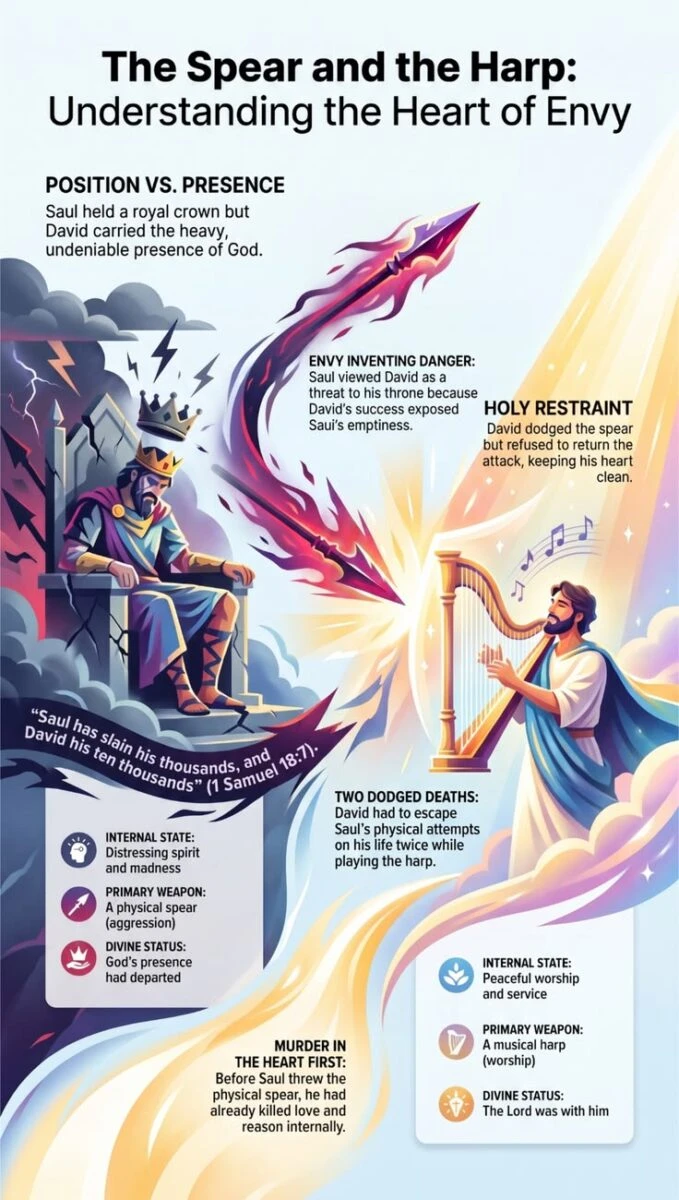
David did not walk into Saul’s court as a rebel. He came as a servant, musician, warrior, and son-in-law in waiting. He soothed Saul’s torment with a harp. He faced Goliath when others froze. He carried victory back to Israel with dust on his sandals. Yet the sound that broke Saul was not the clash of Philistine swords. It was the sound of women singing.
The Bible details this tragic turning point clearly:
“Saul has slain his thousands,
And David his ten thousands.”
— 1 Samuel 18:7 (NKJV)
That song entered Saul’s ears like a nail. We can almost see his face change. A king heard praise for another man and felt smaller than a flea under royal robes. This is the cruel edge of King Saul’s jealousy. Envy does not need proof. It invents danger. It turns honor into insult and friendship into a threat.
The story notes the internal shift:
“Then Saul was very angry, and the saying displeased him…”
— 1 Samuel 18:8 (NKJV)
That small word “displeased” feels too soft until we see what follows. Saul watched David from that day forward. He did not watch him like a mentor. He watched him like a hunter behind a tree. Saul hurled the weapon because jealousy had already thrown truth out of the room. The weapon in his hand was only the second murder. The first one happened inside his heart. He killed love, reason, gratitude, and the fear of God.
A strange thing appears as the narrative unfolds:
“And it happened on the next day that the distressing spirit from God came upon Saul, and he prophesied inside the house. So David played music with his hand, as at other times; but there was a spear in Saul’s hand.”
— 1 Samuel 18:10 (NKJV)
The room should have felt familiar. A lamp may have flickered. Someone may have smelled oil, sweat, and old wood. Then the king gripped the iron weapon.
Why Did Saul Try to Kill David?
Saul tried to kill David because David’s consistent success and divine favor exposed the king’s spiritual emptiness. Saul possessed the crown, the army, and the royal title, but David possessed the undeniable presence of God. This profound contrast triggered a deep, murderous insecurity within Saul’s rebellious heart.
Saul had position, but David had presence. Saul had a throne under him, but David had the Lord with him. The narrative hits us hard here. A person can hold the highest seat and still live terrified of someone with a clean heart. A person can hear worship music and still plan murder. A person can sit near an anointed servant and still hate what God is doing.
Saul attacks David while David serves him. That detail should shake us. David was not shouting insults. He was not stealing the palace. He was not leading a rebellion in the corner. He was simply playing the harp.
There are people who will hate your healing voice because it reminds them of their inner noise. There are people who will hate your obedience because it exposes their rebellion. They may smile in public, then sharpen a weapons in private.
What Is the Meaning of 1 Samuel Chapter 18?
The meaning of 1 Samuel chapter 18 centers on the visible clash between fleshly insecurity and God’s sovereign anointing. It serves as a stern warning against letting envy take root in the soul. The chapter proves that human jealousy cannot void the destiny God has orchestrated for His servants.
The scriptures record the exact moment the weapon flew:
“And Saul cast the spear, for he said, ‘I will pin David to the wall!’ But David escaped his presence twice.”
— 1 Samuel 18:11 (NKJV)
Twice. Let that word sit there like a cold cup on a table. David had to dodge death more than once from the man he served. God teaches us that faithfulness does not always protect us from human cruelty. It protects our souls from becoming cruel back. David escaped, but he did not grab the weapon and return it. That silence is louder than revenge.
Some readers want a cleaner story. We want David praised, Saul corrected, and the palace cleansed before supper. Scripture does not give us that soft version. It shows the wound while it is still open.
The narrative grows darker when we remember Saul’s earlier disobedience. Saul had already rejected the word of the Lord. Samuel told him:
“For rebellion is as the sin of witchcraft,
And stubbornness is as iniquity and idolatry.
Because you have rejected the word of the LORD,
He also has rejected you from being king.”
— 1 Samuel 15:23 (NKJV)
That sentence became a storm in Saul’s bones. David did not create Saul’s downfall. David revealed it. That is often what godly people do without trying. Their light shows dust on the shelf. Their peace makes chaos feel exposed.
Saul attacks because envy cannot stand a future it cannot control. David represented tomorrow. Saul clung to yesterday with bloody fingers. He wanted the kingdom, but he no longer wanted submission to God.
King Saul’s jealousy warns every leader, parent, artist, pastor, worker, and friend. Someone else’s gift is not your funeral. Someone else’s praise is not your punishment. Someone else’s open door is not God forgetting your address.
We whisper this because it hurts. Sometimes we are not David in the story. Sometimes we are Saul.
We feel disturbed when another person rises faster. We hear their name praised and our stomach tightens. We scroll past their blessing and pretend we are fine. The heart lies with a straight face.
Saul threw weapons in the palace, but many people throw spears with words. They throw suspicion. They throw sarcasm. They throw silence. They throw “I am only concerned” while hoping the person fails.
Jesus later exposed this same poison in another form. The rulers envied Him too. Mark says Pilate knew:
“…that the chief priests had handed Him over because of envy.”
— Mark 15:10 (NKJV)
Envy was near the cross. Envy had religious clothes on. That should frighten us. A person can quote Scripture and still hate the one God uses. A person can defend tradition and still resist the Holy Spirit. A person can claim holy concern while holding a hidden weapon.
God is not asking us whether we own a physical weapon. He is asking what we do when another person receives honor. He is asking what rises inside us when someone younger, poorer, or less known walks in with favor.
David did not control Saul’s jealousy. He controlled his own hands. That is where the lesson burns clean. You may not stop every spear, but you can refuse to become a spear thrower.
David kept walking under God’s protection:
“Saul was afraid of David, because the LORD was with him, but had departed from Saul.”
— 1 Samuel 18:12 (NKJV)
That line explains more than the attack. Saul feared David because David carried what Saul lost. The presence of God is heavier than a crown. It is stronger than a title. It is brighter than applause. Saul still looked like a king, but heaven had moved.
David reminded him of God’s nearness. That is a painful truth. Some people do not hate you because you harmed them. They hate you because your obedience reminds them of the voice they ignored.
This does not make you proud. It should make you tremble. Favor is not a toy. Anointing is not perfume for ego. God lifts a person for service, not self-worship.
How Did David Escape Saul’s Repeated Attacks?
David escaped Saul’s repeated attacks through divine protection and by recognizing when it was time to exit the toxic environment. He refused to retaliate in anger or trade blow for blow. Instead, David relied entirely on the Lord as his ultimate shield while maintaining a clean, submissive heart.
David’s harp matters. He did not enter the room with a sword. He entered with music. Worship was in his hands when hatred flew at him. A young man plays before a tormented king. The strings vibrate. The room tightens. A sharp edge cuts the air. Worship and murder share the same room for one awful second.
We learn that worship can disturb darkness. It can soothe, but it can also expose. It can bring peace to the humble and rage to the proud. The same song that heals one heart may irritate another.
The text does not tell us to fear jealous people. It tells us to fear becoming one. Saul’s tragedy did not begin with a weapon. It began with a heart that stopped bowing before God.
Guard your heart when someone else is celebrated. Pray fast before envy grows teeth. Bless them before bitterness builds a throne. Say their name kindly before your soul learns to spit it out.
David’s destiny does not die. That is the mercy hidden in the terror. A weapon can fly, but it cannot cancel God’s word. A jealous person can delay peace, but cannot dethrone Almighty God.
David escaped twice. Not once. Twice.
Maybe that is for the reader who has dodged the same pain many times. The same accusation. The same family wound. The same workplace sabotage. The same cold look from someone you served with a clean heart.
God saw the danger before David moved. God saw Saul’s grip tighten. God saw the wall waiting behind David’s back. Heaven was not surprised. King Saul’s jealousy may explain the attack, but it does not get the final word. God’s covenant speaks louder. God’s calling stands longer. God’s hand reaches deeper than human hatred.
David would later write:
“The LORD is my light and my salvation;
Whom shall I fear?
The LORD is the strength of my life;
Of whom shall I be afraid?”
— Psalm 27:1 (NKJV)
That was not a cute line for a wall poster. That was survival language. That was a man breathing after death passed close enough to touch his skin. David learned where true safety lives. Not in a palace. Not in royal approval. Not in public praise. Safety lives in God.
We need that truth because many still beg Saul to love them. We keep playing the harp in rooms where weapons keep flying. We call it patience when it may be fear. We call it loyalty when God may be teaching us to escape.
David escaped Saul’s presence. That phrase matters. Sometimes obedience means leaving the room. Sometimes faith does not stand still under abuse and call the bleeding holy. Sometimes God opens a door while the weapon is still shaking in the wall.
Envy made Saul blind to the gift God placed near him. David could have been Saul’s greatest ally. Instead, Saul treated him like an enemy. Sin wastes blessings before it destroys people.
This is where the story becomes a mirror with no mercy. Who has God placed near us that we secretly resent? Whose growth have we misread as a threat? Whose song have we tried to silence because it made our own silence feel too loud?
The Bible refuses to hide the ugliness of a jealous heart. That honesty is grace. God shows the monster before it learns our name. He lets us see the weapon before our fingers close around it.
The cure is not self-esteem. Saul had status. The cure is surrender. The cure is repentance before the Lord. The cure is a heart that cries out:
“Create in me a clean heart, O God,
And renew a steadfast spirit within me.”
— Psalm 51:10 (NKJV)
David was not perfect, but in this moment he shows us restraint. He escapes, but he does not become Saul. That may be one of the hardest miracles in Scripture. To survive hatred without becoming hateful is holy warfare.
The innocent man lives. The wall receives the wound meant for him. The weapon sticks somewhere, useless and ashamed. God’s servant keeps breathing.
Maybe your name has been thrown across rooms you never entered. Maybe someone’s jealousy has painted you as proud, dangerous, or false. Maybe you served with clean hands and still became a target. The Bible does not mock that pain.
The Lord sees every hidden weapon. He sees the ones thrown by family, leaders, friends, and wounded people who never dealt with their own darkness. He also sees the weapon forming inside us. That may be the more frightening mercy.
King Saul’s jealousy is not old dust. It is a living warning. The palace is still full. The harp is still playing. The weapon is still near someone’s hand.
Saul throws a spear at David, but the deeper shock is this: the attack did not prove David was unsafe. It proved Saul was already collapsing. As you focus on your personal journey of spiritual growth, remember to guard your heart against envy. Will we drop the weapon before the wall carries our shame?