


Revenge can feel holy when pain has been preaching to us for too long. That is the terrifying secret behind David sparing Saul’s life in the cave. A man can hold a knife, hear his enemy breathing in the dark, and still call it justice. To grow deeper in your walk, you can discover resources on how love transforms our response to betrayal. Choosing restraint over retaliation defines true spiritual maturity.
The cave was quiet, but David’s heart was standing before God. Saul walked into that cave as a hunted king hunting an innocent man. David was hiding there with his men, pressed into the shadows like forgotten bones. The air may have smelled of dust, sweat, and fear. Then came the moment that could have ended everything.
“Then the men of David said to him, ‘This is the day of which the LORD said to you, “Behold, I will deliver your enemy into your hand, that you may do to him as it seems good to you.”’ And David arose and secretly cut off a corner of Saul’s robe.”
1 Samuel 24:4, NKJV
That small piece of cloth became louder than a scream.
David spares Saul in the cave does not begin with softness. It begins with power. David could have killed Saul. His friends wanted him to do it. The situation looked like a divine setup, the kind of moment people twist into permission. Be careful with open doors. Some doors do not lead to destiny. Some lead to blood.
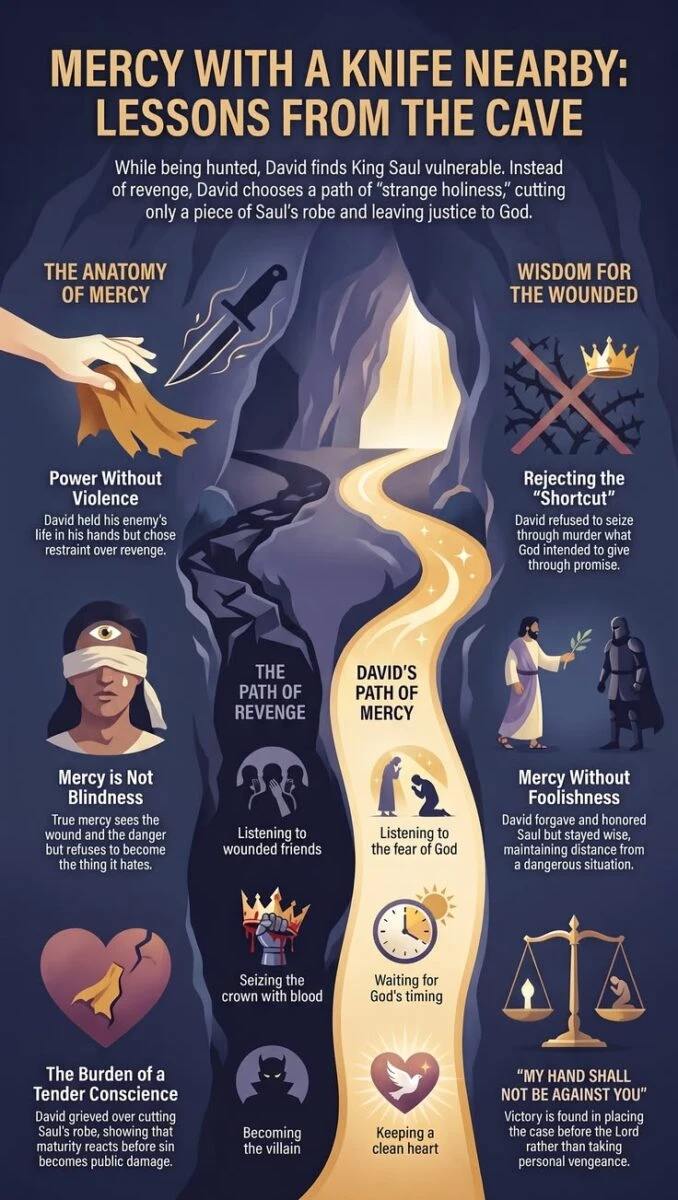
David crept near Saul and cut the robe. That act alone shook him. His conscience started burning. Many people would have celebrated restraint because they did not kill the man. David grieved because he had dishonored the king’s robe. That is strange holiness.
“Now it happened afterward that David’s heart troubled him because he had cut Saul’s robe.”
1 Samuel 24:5, NKJV
Most people regret sin after damage spreads across the floor. David felt pain after touching the edge of revenge. He did not need blood on his hands to know danger had entered his heart.
This is why David sparing Saul in the cave still cuts deep. The story does not flatter us. It exposes the private courtroom inside us where we judge people, sentence them, and pretend God signed the order.
Why Did David Choose to Spare King Saul?
Saul deserved judgment. Let us not soften the facts. King Saul’s jealousy of David had turned violent. He had thrown spears. He had chased David through the wilderness. He had treated loyalty like treason.
David had served him. David had honored him. David had played music for his tormented mind. Still, Saul became the kind of man who saw a faithful servant as a threat. That is what envy does. It turns a palace into a prison. It makes a king afraid of a shepherd.
Inside the cave, David’s men spoke with religious confidence. They saw Saul’s weakness and called it God’s gift. They saw the enemy within reach and called it timing. Their words sound familiar because we still use spiritual language to excuse wounded anger.
“God opened the door.”
Maybe He did. Maybe He opened it to test what you would do with a blade in your hand.
David cuts Saul’s robe instead of Saul’s throat. That detail matters. David did not pretend Saul was harmless. He did not deny the danger. He chose mercy without denying reality.
Biblical mercy is not blindness. It sees the wound. It sees the weapon. It sees the long nights. Then it kneels before God and refuses to become the thing it hates.
“And he said to his men, ‘The LORD forbid that I should do this thing to my master, the LORD’s anointed, to stretch out my hand against him, seeing he is the anointed of the LORD.’”
1 Samuel 24:6, NKJV
David’s restraint was not weakness. It was fear of God. He feared touching what God had marked, even when that man had become cruel. That sentence can make us uncomfortable.
We want clean stories. We want villains with no dignity left. We want enemies so ugly that mercy looks foolish. The Bible refuses that easy path. Saul was wrong, dangerous, unstable, and still not David’s to destroy.
David spares Saul in the cave because David knows the throne does not belong to rage. God had promised him the kingdom, but David refused to seize with murder what God intended to give through promise.
There is a deep warning here for anyone waiting on God. A shortcut can look like answered prayer. A chance to strike back can feel like breakthrough. A cruel person can step into your cave, and every hurt inside you may start singing, “Now. Do it now.”
The lamp flickers. The knife shines. Your soul leans forward. Then God watches.
David would rather stay hunted than become polluted. That is the part we avoid. We often want God’s promise with our enemy’s blood on the doorway. David chose a harder road. He chose a clean heart.
What Does Cutting the Robe Mean in the Bible?
Biblical stories of forgiveness and mercy do not remove justice from God’s hands. They place justice back where it belongs. David spared Saul, but he did not call Saul innocent. He stepped out of the cave and confronted him.
“David also arose afterward, went out of the cave, and called out to Saul, saying, ‘My lord the king!’ And when Saul looked behind him, David stooped with his face to the earth, and bowed down.”
1 Samuel 24:8, NKJV
That bow must have felt like swallowing fire.
David honored Saul without approving Saul’s sin. He spoke truth without becoming vicious. He showed the piece of robe and let evidence speak. No screaming. No spear. No secret assassination dressed as destiny.
David sparing Saul in the cave teaches us that mercy can be bold. Mercy can walk into daylight. Mercy can say, “Look what I could have done, and look what I chose instead.”
This is not the weak forgiveness that pretends abuse never happened. This is not the fake peace that lets evil keep eating the house. David spoke. David named the wrong. David placed the case before the Lord.
“Let the LORD judge between you and me, and let the LORD avenge me on you. But my hand shall not be against you.”
1 Samuel 24:12, NKJV
There it is. The sentence that breaks the old human machine.
“My hand shall not be against you.”
Try saying that when someone lied about you. Try saying that when your name was dragged through dirt. Try saying that when the person who wounded you still sleeps well.
The flesh hates this verse. It wants a smaller god and a faster weapon.
David did not forgive because Saul earned it. He spared Saul because God ruled him. That is the great divide. Some people refuse revenge because they fear consequences. David refused revenge because he feared the Lord.
David cuts Saul’s robe and then feels convicted. That small grief tells us something about spiritual maturity. A tender conscience reacts before sin becomes public damage. We need that again.
Many hearts today can cut people to pieces with words and feel nothing. We can post, expose, mock, shame, and call it truth. Then we sleep with cold souls and glowing screens near our faces.
David trembled over a robe. What would he say about our tongues?
David sparing Saul’s life also shows the danger of listening to wounded friends. David’s men were loyal to him, but their advice could have stained him forever. They loved David, yet they almost pushed him into sin.
Not every loyal voice is a holy voice.
Some friends feed your bitterness because your anger makes sense to them. They know your tears. They remember the injustice. They want you defended. Still, a friend can love you and tempt you.
The cave had more than Saul inside it. It had pressure. It had prophecy language. It had pain. It had men waiting to cheer for blood. David stood alone before God in a room full of agreement. That is leadership.
How Does True Biblical Mercy Overcome Revenge?
Biblical stories of forgiveness and mercy often force one person to stop the cycle. Joseph did it with his brothers. Stephen did it while stones flew. Jesus did it from the cross. David did it with Saul’s robe in his hand. Mercy always looks strange to people who worship revenge.
Saul’s response was emotional. He lifted his voice and wept. For one brief moment, the king saw himself clearly. That sight must have hurt.
“Then he said to David: ‘You are more righteous than I; for you have rewarded me with good, whereas I have rewarded you with evil.’”
1 Samuel 24:17, NKJV
Saul knew. That may be the most frightening part.
Some people know you are innocent and still fight you. Some people know they are wrong and still return to the spear later. Tears do not always mean transformation. A broken voice does not always mean a broken will.
David did not return to Saul’s house that day. Read that again slowly. He forgave. He spared. He honored. He confronted. He did not hand Saul the keys to his future.
Mercy does not require foolish closeness. Forgiveness does not mean standing where the spear can reach your chest again. David’s heart stayed clean, but his feet stayed wise.
David’s act of sparing Saul in the cave gives wounded believers a holy pattern. Do not kill. Do not pretend. Do not become cruel. Do not call revenge obedience. Speak truth. Leave judgment with God. Keep walking.
The cave becomes a classroom. The teacher is not Saul. It is not David’s men. It is not even the robe. The teacher is the fear of the Lord, that deep trembling love that says, “I would rather lose my chance than lose my soul.”
There are moments when God lets your enemy come close, not because He wants you to strike, but because He wants to reveal you. The hidden you. The one beneath prayers and songs. The one who still imagines revenge while quoting Scripture. That truth stings.
You may never stand in a cave with a king asleep nearby. You may never hold a blade near the man who ruined your peace. Yet you will face your own cave. A message you could send. A rumor you could confirm. A secret you could expose. A silence you could weaponize.
The corner of the robe changes shape with every generation. Maybe your robe corner is a screenshot. Maybe it is a family weakness. Maybe it is one private story that could destroy someone who wounded you.
You can cut it. You can carry it. You can prove your point. Then your heart may trouble you in the night.
David cuts Saul’s robe because he is still learning. David spares Saul in the cave because God is ruling deeper than anger. That is where grace enters the story, not like soft music, but like a command in the dark.
Stop. Do not touch him. Let God judge.
This story does not ask us to trust people who keep harming us. It asks us to trust God more than we trust revenge. That difference matters. One is wisdom. The other is surrender.
Biblical stories of forgiveness and mercy carry blood, tears, trembling hands, and hard obedience. They are not greeting cards. They are battlefields where the real enemy is often inside the chest.
David walked out alive that day. Saul walked out alive too. The robe stayed torn. The relationship stayed dangerous. The promise stayed alive. God did not need David to sin in order to make him king. That may be the message someone needs tonight.
God does not need your bitterness to defend you. He does not need your revenge to lift you. He does not need your hidden knife to fulfill His spoken word.
David spares Saul in the cave because the future king had to learn that a throne gained by bloodlust becomes a curse. The kingdom would come. The crown would come. The songs would come. Yet God wanted David’s hands clean before the oil of promise became the weight of rule.
What if your delay is protecting your soul? What if God is teaching you mercy before He trusts you with influence? What if the person you want to destroy is the test that proves whether you can carry the blessing you begged for?
The cave is still open. The enemy may be near. The knife may be close. Your friends may be whispering that this is your moment. Yet the Lord may be asking one dreadful, holy question from the dark.
Will you still obey Me when revenge feels like justice?
To deepen your understanding of these biblical dynamics, explore foundational truths about Christian living that form the core of daily discipleship. By aligning your choices with scriptural boundaries, you invite God to fight your battles while keeping your character unpolluted.


