There are moments when I read the words of Jesus and realize how deeply they confront the human heart. The meaning of the Parable of the Sower reaches far beyond an old farming story. It exposes what happens inside you when you hear the Word of God. The same seed falls. The results are completely different.
You know what? That should make you stop and think. You can sit in church, read Scripture, hear sermons, and still respond with a heart that refuses to change. I want you to notice something: Jesus did not blame the seed. He focused on the soil. That truth can change how you see your faith.
If you want to explore more teachings like this, you can read these Jesus parables explained.
Why Does the Sower Parable Matter Today?
The meaning of the Parable of the Sower is simple but severe: God’s Word is the same seed, yet people respond to it in very different ways. Some hear and reject it, some receive it briefly, some let worries choke it, and some receive it deeply and bear lasting spiritual fruit.
Jesus began this parable beside the Sea of Galilee. A large crowd gathered around Him, and He taught them through a picture they understood. Farmers knew that seed could land on different kinds of ground.
“A sower went forth to sow; And when he sowed, some seeds fell by the way side, and the fowls came and devoured them up: Some fell upon stony places, where they had not much earth: and forthwith they sprung up, because they had no deepness of earth: And when the sun was up, they were scorched; and because they had no root, they withered away. And some fell among thorns; and the thorns sprung up, and choked them: But other fell into good ground, and brought forth fruit, some an hundredfold, some sixtyfold, some thirtyfold.” (Matthew 13:3-8, KJV)
Here’s the bottom line. The seed was good every time.
The difference was the soil.
That makes this parable uncomfortable. You cannot blame the preacher, the Bible, or the message every time you fail to grow. Sometimes the real problem is what happens inside you after you hear God’s truth.
What Does the Seed Represent in the Parable?
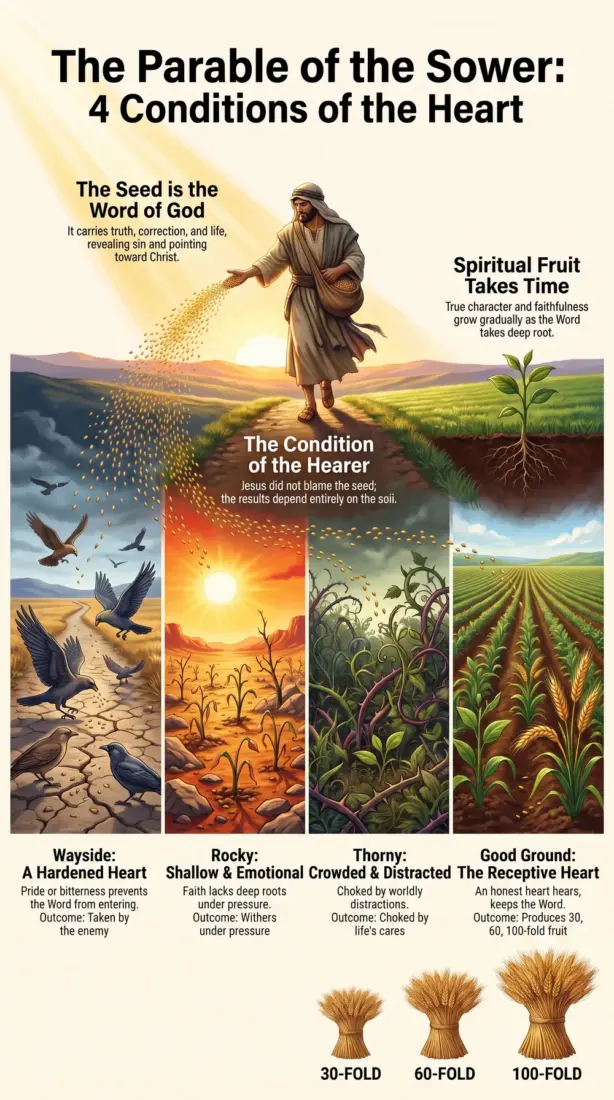
The seed represents the Word of God, while the soil represents the human heart that hears it. Jesus showed that the power of the seed is not the problem. The real issue is the condition of the hearer.
God’s Word can enter your life, yet your response determines whether it takes root and produces fruit.
Jesus explained the mystery privately to His disciples.
“Now the parable is this: The seed is the word of God.” (Luke 8:11, KJV)
That sentence gives us the key.
The seed is not human wisdom. It is God’s Word. The Word carries truth, correction, promise, warning, and life. It reveals sin and points you toward Christ.
Now let me tell you this. Hearing God’s Word is only the beginning.
You can hear a powerful sermon and remain unchanged. You can highlight dozens of Bible verses and refuse to obey one. You can know what Scripture says while allowing your heart to resist it.
I truly believe this is why Jesus used farming as His picture. A seed must enter the ground. It must remain there. It must grow roots.
Faith works the same way.
Why Did Jesus Describe Four Types of Soil?
Jesus described four soils because people can hear the same truth and still respond in opposite ways. The wayside shows a hardened heart, rocky ground shows shallow faith, thorny soil shows a crowded heart, and good soil shows a receptive heart that obeys God and produces lasting fruit.
The first soil was hard ground beside the path. The seed could not enter it.
Jesus explained that Satan takes away the Word from hardened hearts before it can produce faith.
“Those by the way side are they that hear; then cometh the devil, and taketh away the word out of their hearts, lest they should believe and be saved.” (Luke 8:12, KJV)
That is a serious warning.
A hard heart may develop through pride, repeated disobedience, bitterness, or stubbornness. The danger is not that the person never hears God’s Word. The danger is that the person hears it and refuses to let it enter.
Then comes the rocky soil.
This person receives the Word with excitement but has no deep root. When trouble comes, faith collapses.
I want you to think about that. Strong emotions are not the same as strong faith.
Real faith must survive pressure.
The third soil contains thorns. Jesus connects these thorns with cares, riches, pleasures, and the distractions of life.
“And that which fell among thorns are they, which, when they have heard, go forth, and are choked with cares and riches and pleasures of this life, and bring no fruit to perfection.” (Luke 8:14, KJV)
This may be the most relatable soil today.
You may love God, yet allow money, entertainment, fear, comfort, ambition, or endless distractions to crowd Him out.
Nothing has to look evil at first. It only has to become more important than obedience.
🛑 A crowded heart can become a fruitless heart.
How Can You Become Good Soil for God?
You become good soil by hearing God’s Word with an open heart, receiving it deeply, resisting distractions, and obeying what God says. Good soil is not a perfect person. It is a willing heart that lets truth take root, endure pressure, and produce visible fruit through faithful living.
Jesus described good soil with a powerful phrase: “an honest and good heart.”
“But that on the good ground are they, which in an honest and good heart, having heard the word, keep it, and bring forth fruit with patience.” (Luke 8:15, KJV)
Notice the movement.
They hear.
They keep the Word.
They produce fruit.
That changes everything.
Good soil does not mean you never struggle. It means you refuse to let struggle become an excuse for disobedience. You keep receiving God’s truth, even when it corrects you.
Can I tell you something?
Spiritual fruit takes time.
An apple tree does not appear overnight. The same is true of character. Love, patience, obedience, self-control, humility, and faithfulness grow as God’s Word takes deeper root.
I can honestly say that this is where many people want the reward without accepting the process. They want strong faith without deep roots. They want peace without surrender. They want God’s promises without God’s correction.
That does not work.
Theological language calls this sanctification, the ongoing work by which God shapes believers into greater holiness and Christlike character. Scripture connects spiritual growth with abiding in Christ and bearing fruit.
Jesus said:
“Herein is my Father glorified, that ye bear much fruit; so shall ye be my disciples.” (John 15:8, KJV)
The world often defines success by money, status, influence, or applause.
God measures something deeper.
Fruit.
The Real Warning Behind the Sower’s Story
The deepest warning is not that God’s Word lacks power. The warning is that you can hear divine truth repeatedly while refusing to let it transform your life. Jesus forces you to examine your heart, because spiritual exposure without obedience can leave you unchanged, distracted, shallow, or hardened.
This is something special about the parable.
Jesus does not invite you to inspect everyone else’s soil.
He invites you to inspect your own.
It is easy to say, “That person is hard-hearted.” It is harder to ask, “Where have I become hard?”
It is easy to identify someone controlled by money. It is harder to ask whether your own desires have crowded out God.
It is easy to criticize shallow Christians. It is harder to admit that your own roots may be weak.
⚡ The Parable of the Sower turns the mirror toward you.
Here’s what I’ve learned from the message of Jesus: God’s Word deserves more than a quick reaction. It deserves a place in your heart, your choices, your habits, and your daily life.
You might be surprised by this, but the good soil is not described as the smartest soil. Jesus did not praise the person with the most Bible knowledge.
He praised the person who heard, kept, and produced fruit.
That means you can start today.
Open the Bible.
Listen carefully.
Obey what God reveals.
Remove the thorns.
Let your roots grow deep.
Then keep going.
What Should You Do With This Parable?
The meaning of the Parable of the Sower demands a personal response: examine your heart, receive God’s Word, remove spiritual distractions, develop deep roots, and practice obedience. Do not settle for hearing Scripture without change. Ask God to make your heart receptive, faithful, and fruitful through His truth and grace.
I started this message by talking about the same seed producing different results. Now the question comes back to you.
What kind of soil are you?
Maybe your heart has become hard. Let God soften it.
Maybe your faith has become shallow. Let God deepen it.
Maybe life’s worries have filled your heart with thorns. Remove what is choking your spiritual growth.
Or perhaps God is already producing fruit in you. Keep going.
The answer is not complicated.
Hear the Word. Keep the Word. Live the Word. Bear fruit.
Do not read this parable and move on unchanged. Stop for a moment and examine your heart before God.
Then leave your raw thoughts in the comments. Tell me honestly: Which soil describes your heart right now, and what do you believe God is asking you to change?
One last question… Are you inspired by this article and looking to deepen your walk with the Lord? Discover more encouraging truths designed to nurture your spiritual journey.