I want to tell you something about the parable of the mustard seed meaning that can change how you see your small beginnings. You may look at your prayer, ministry, faith, gift, or one small act and think, “This cannot become much.” Yet Jesus chose a tiny seed to reveal a kingdom truth that can shake that thinking.
If we’re being honest, we often measure God’s work by what we can see today. I have learned that God does not need a large beginning to produce a great result. He needs something surrendered to Him.
If you want more biblical insight like this, explore these biblical teachings on Jesus’ parables.
Why Does the Mustard Seed Really Matter?
The parable of the mustard seed meaning points to the surprising growth of God’s Kingdom. Jesus showed that something appearing tiny can become remarkably large under God’s power. The beginning may look weak, hidden, or unimpressive, yet God’s work can grow beyond human expectation and reach many lives.
Jesus said:
“Another parable put he forth unto them, saying, The kingdom of heaven is like to a grain of mustard seed, which a man took, and sowed in his field: Which indeed is the least of all seeds: but when it is grown, it is the greatest among herbs, and becometh a tree, so that the birds of the air come and lodge in the branches thereof.”
(Matthew 13:31-32, KJV)
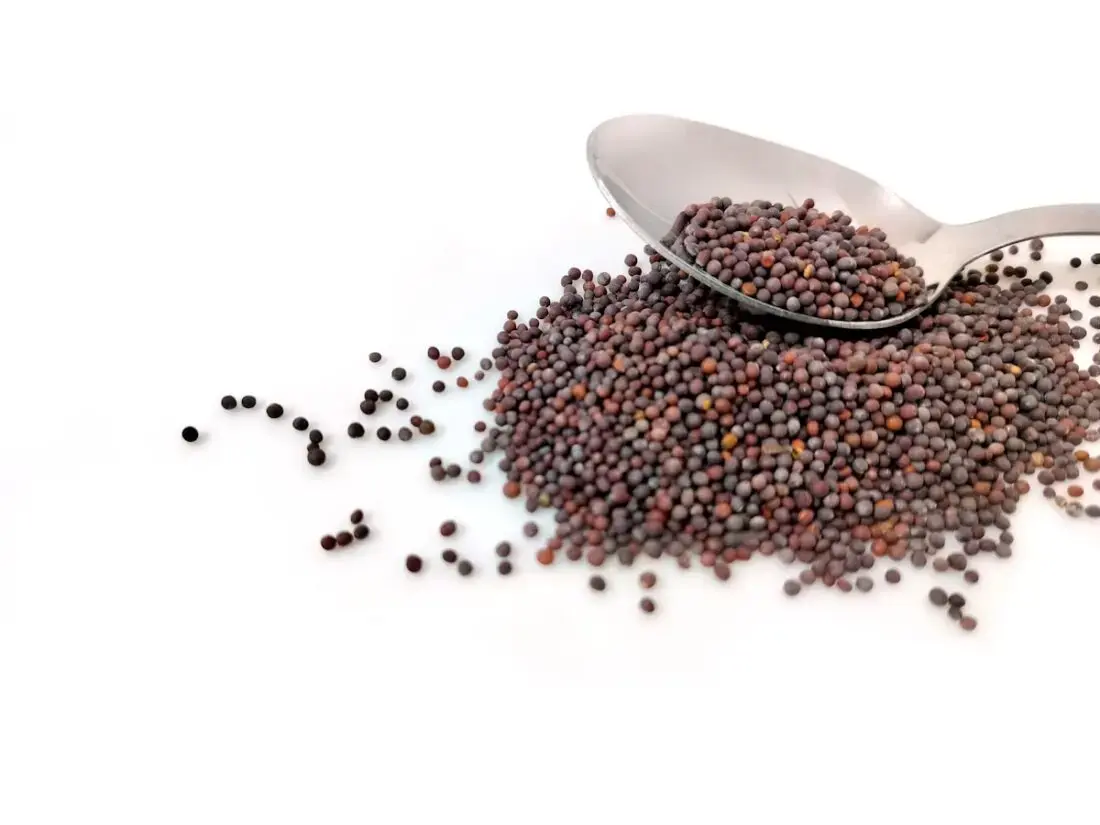
That picture is powerful. A seed does not look like a tree. You cannot hold the future tree in your hand. You hold a seed.
That is the point.
The Kingdom of God began its earthly announcement through Jesus, a humble teacher from Nazareth. His public ministry did not resemble a political empire. He had no earthly throne. Yet His message spread across nations.
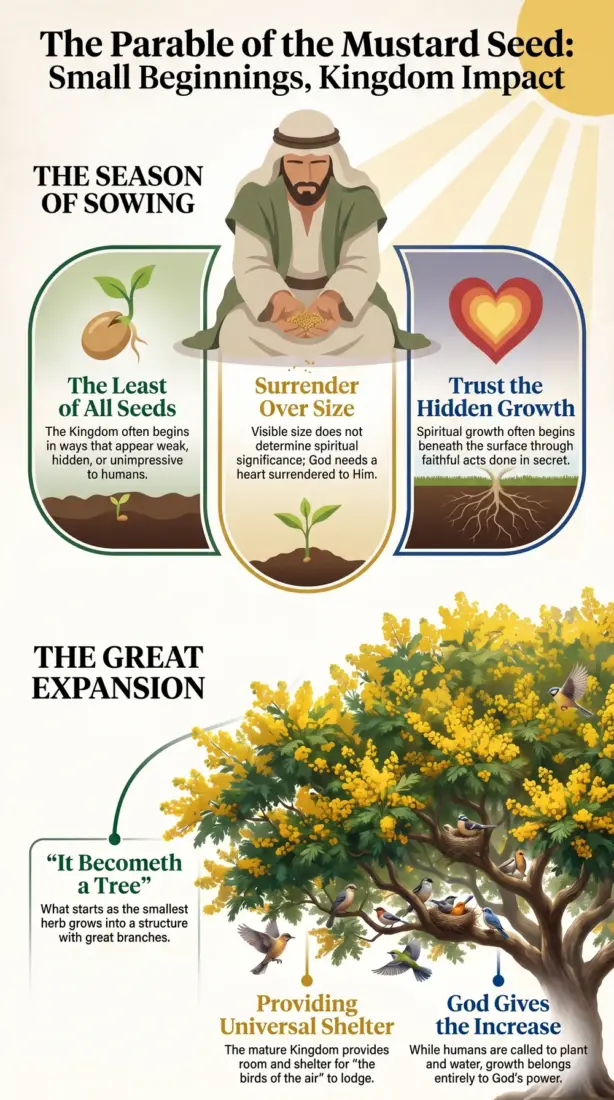
The mustard seed reminds you that visible size does not determine spiritual significance. God can start something quietly.
What Does the Mustard Seed Symbolize?
The mustard seed symbolizes the Kingdom of God and its surprising growth from a seemingly insignificant beginning. Jesus used familiar farming imagery to show that God’s reign would grow far beyond what people could see at first. The lesson is about divine growth, kingdom expansion, and God’s power working through small beginnings.
You might be surprised by this. The parable is specifically about the Kingdom of Heaven, not simply about having strong personal faith. Matthew makes that clear.
Mark records the same teaching:
“And he said, Whereunto shall we liken the kingdom of God? or with what comparison shall we compare it? It is like a grain of mustard seed, which, when it is sown in the earth, is less than all the seeds that be in the earth: But when it is sown, it groweth up, and becometh greater than all herbs, and shooteth out great branches; so that the fowls of the air may lodge under the shadow of it.”
(Mark 4:30-32, KJV)
The seed becomes a picture of kingdom expansion. What starts small develops into something that provides room and shelter.
This also connects with Old Testament imagery. Ezekiel described a small branch becoming a great tree where birds could dwell. The image points toward God’s rule becoming visible and extensive.
I want you to notice something. Jesus did not say the seed stays small. Growth is part of the story.
Why Does Jesus Compare Faith to Seeds?
Jesus compares faith to a mustard seed because seed imagery shows how something small can produce a result far greater than its appearance suggests. Yet this parable concerns the Kingdom, while other passages use the mustard seed to illustrate faith. Keeping those teachings distinct gives you a clearer biblical understanding.
Luke gives another version of the parable:
“Then said he, Unto what is the kingdom of God like? and whereunto shall I resemble it? It is like a grain of mustard seed, which a man took, and cast into his garden; and it grew, and waxed a great tree; and the fowls of the air lodged in the branches of it.”
(Luke 13:18-19, KJV)
Here is where many readers make a mistake. They see “mustard seed” and immediately think of Matthew 17:20, where Jesus speaks about faith.
That connection is useful, but the passages have different immediate subjects.
Matthew 13 concerns the Kingdom. Matthew 17 concerns faith.
Both use the same striking image. Both challenge your habit of judging things by their starting size.
Now let me tell you this: small does not mean useless.
A small act of obedience can open a door. A short prayer can begin a change. One faithful teacher can influence generations. One Gospel message can reach someone who later reaches thousands.
God sees what you cannot see.
How Does Small Faith Become Powerful?
Small faith becomes powerful when it rests in a great God rather than in its own size. Biblical faith does not boast about human strength. It trusts God’s character, obeys His Word, and acts despite limited circumstances. The power comes from God, while faith becomes the means through which you respond to Him.
Jesus said:
And he said unto them, Because of your unbelief: for verily I say unto you, If ye have faith as a grain of mustard seed, ye shall say unto this mountain, Remove hence to yonder place; and it shall remove; and nothing shall be impossible unto you.
(Matthew 17:20, KJV)
The emphasis is not that you must somehow manufacture a magical amount of faith. Faith matters because of the One you trust.
Think about a seed again. Its power is not found in its appearance. You bury it. You wait. You water it. You trust the process God built into creation.
The same principle can shape your spiritual life.
You may feel weak while God is working.
That does not mean nothing is happening.
❖ Do not measure God’s work by today’s appearance. Measure your obedience by God’s Word.
The Kingdom Starts Smaller Than Expected
Jesus deliberately chose a tiny seed to challenge human expectations about God’s Kingdom. People expected power to appear through size, status, force, or public glory. Jesus showed that God’s kingdom could begin quietly and still grow into something vast, powerful, and deeply influential.
The disciples themselves experienced this lesson.
Jesus began with a small group of ordinary people. They were fishermen, a tax collector, and other unlikely followers. They did not look like the leaders of a movement that would cross the globe.
Yet the Gospel spread.
Acts records the growth of the early Church. Peter preached, people believed, and the message moved outward. The kingdom message did not remain inside one small room.
This is part of the Parable of the Mustard Seed Meaning that many people miss. Jesus was teaching His hearers to stop judging God’s Kingdom by its early appearance.
I truly believe that principle still confronts us today.
You may see one person reading your message. God may see the people that person will influence.
You may see one child learning Scripture. God may see a future preacher.
You may see one quiet act of obedience. God may see its eternal fruit.
God Can Grow What You Cannot Yet See
God can grow what you cannot yet see because spiritual growth often begins beneath the surface. A planted seed looks buried, not successful. Yet God’s design allows hidden roots to form before visible growth appears, teaching you to trust Him during seasons when results remain unseen.
This is where patience becomes important.
A seed needs time. You cannot scream at the soil and make the plant grow faster. You cannot dig it up every morning to check whether it has changed.
Faith requires trust during hidden seasons.
You know what? Some of your greatest spiritual growth may happen when nobody notices you.
You pray when nobody applauds. You study Scripture when nobody knows. You resist temptation when nobody sees. You keep serving when the results look small.
That matters.
God is not impressed by appearances. He looks at the heart.
The world often says, “Make it big.” God says, “Be faithful.”
That difference can change everything.
What the Mustard Seed Teaches You Today
The parable of the mustard seed meaning teaches you to value faithful beginnings, trust God’s growth, and refuse to despise what looks small.
Our responsibility is to plant, obey, pray, and remain faithful. God’s responsibility includes the growth that exceeds our ability, timing, resources, and present understanding.
I want you to think about that.
You do not need thousands of followers to obey God. You do not need a huge ministry before your service matters. You do not need perfect circumstances before taking the next faithful step.
Maybe your beginning feels painfully small.
Start anyway.
If God gave you a gift, use it. If He gave you a message, share it. If He gave you an opportunity to serve, serve faithfully.
Small obedience is still obedience.
Jesus did not praise the seed for looking impressive. He showed what happened after it was planted.
That distinction matters.
Do Not Despise Your Small Beginning
Never despise your small beginning because God often works through ordinary acts that seem insignificant at first. A small beginning can carry a large purpose when it is surrendered to God. Your present size does not place a limit on what God can accomplish through faithful obedience.
The prophet Zechariah gave Israel this powerful reminder:
“For who hath despised the day of small things? for they shall rejoice, and shall see the plummet in the hand of Zerubbabel with those seven; they are the eyes of the LORD, which run to and fro through the whole earth.”
(Zechariah 4:10, KJV)
That question still speaks.
Who told you that small means worthless?
Maybe your first sermon has only a few listeners. Preach it faithfully.
Maybe your first song reaches a small audience. Sing it faithfully.
Maybe your prayer feels weak. Pray anyway.
Maybe your Bible study has only one person. Teach that person.
⚡ Never insult a beginning because it does not resemble the ending.
When God Turns Little Into Much
The parable of the mustard seed meaning shows that God can take what appears insignificant and bring remarkable growth from it. The seed is small, yet its mature form becomes large enough for birds to find shelter. Jesus uses that contrast to reveal the surprising scale of God’s kingdom work.
This is something special.
God often works through what people overlook.
David looked too young to matter. Gideon felt too weak to lead. The disciples lacked the status people expected from religious leaders.
Yet God worked through them.
I can honestly say this is one of the strongest lessons in the parable: you should never confuse your current condition with God’s final purpose.
Your beginning is not your conclusion.
Your present limitation is not God’s limitation.
Your small resource is not His shortage.
Your Small Step Can Become a Testimony
Your small step can become a testimony when you place it under God’s direction and keep walking faithfully. You may not see immediate results, but obedience can create opportunities, influence people, strengthen faith, and advance God’s purposes in ways you could never calculate beforehand.
Let me ask you something.
What small thing has God placed in your hands?
Maybe you already know.
Then stop waiting for a larger opportunity.
Use what you have.
The widow in Scripture gave what looked tiny (two small copper coins [mites]) compared with the needs around her. Jesus noticed her offering because God measures surrender differently from human applause.
Your small act can carry great meaning when love and obedience stand behind it.
God does not need your greatness. He wants your faithfulness.
That truth cuts through comparison.
Let God Grow What You Place in His Hands
The parable of the mustard seed meaning calls you to trust God’s power over your limited beginnings. Plant what God gives you, remain faithful, and refuse to quit because progress looks slow. The seed teaches patience, kingdom hope, humble obedience, and confidence that God can produce growth beyond your natural ability.
But here’s what I discovered: growth belongs to God.
Paul expressed this clearly when he described ministry:
“I have planted, Apollos watered; but God gave the increase.”
(1 Corinthians 3:6, KJV)
That is the balance you need.
Plant. Water. Trust God.
Do your part without pretending you control the outcome.
You may never know how far one prayer travels. You may never know who was strengthened by one sentence you shared. You may never see the full fruit of your obedience on earth.
Still, keep planting.
Your Small Beginning Is Not Your Ending
The Parable of the Mustard Seed reaches deep into the struggle many people face: you see something small and assume it cannot become significant. Jesus destroys that assumption. God’s Kingdom can begin in ways that appear unimpressive, yet His purpose can produce growth far beyond human expectations.
I want you to remember the person from the beginning of this article who wondered whether a small beginning could matter. Maybe that person is you.
Do not bury what God told you to plant.
Do not abandon your calling because the numbers look small.
Do not compare your seed with somebody else’s tree.
Keep going.
The seed has a future you cannot see.
Your job is faithfulness. God’s work includes the increase.
If this message challenged you, leave your raw thoughts in the comments. Tell me what small beginning you are trusting God to grow, and let your words encourage someone who is close to giving up.
Explore more biblical teachings for deeper lessons from God’s Word.