
Some blessings come only after God wounds the part of you that refuses to surrender. That is the hard truth behind the night Jacob wrestled with God beside the Jabbok River. You may crave instant comfort, but God will often touch your strongest place before He gives you a new name. The man who limped away from that match was not weaker than before; he was finally real.
Understanding how God transforms our deepest pain is an essential component of receiving true biblical blessings. By aligning our hearts with His Word during these intense trials, we learn to move past temporary earthly comfort and step directly into a life of lasting spiritual abundance.
Why Did Jacob Wrestle with God at the Jabbok River?
Direct Answer: Jacob wrestled with God at the Jabbok River because he reached a point of absolute isolation, fear, and desperation before facing his brother Esau. Stripped of his wealth, human strategies, and survival instincts, God confronted Jacob to break his self-reliance and force him to seek true divine favor instead of human manipulation.
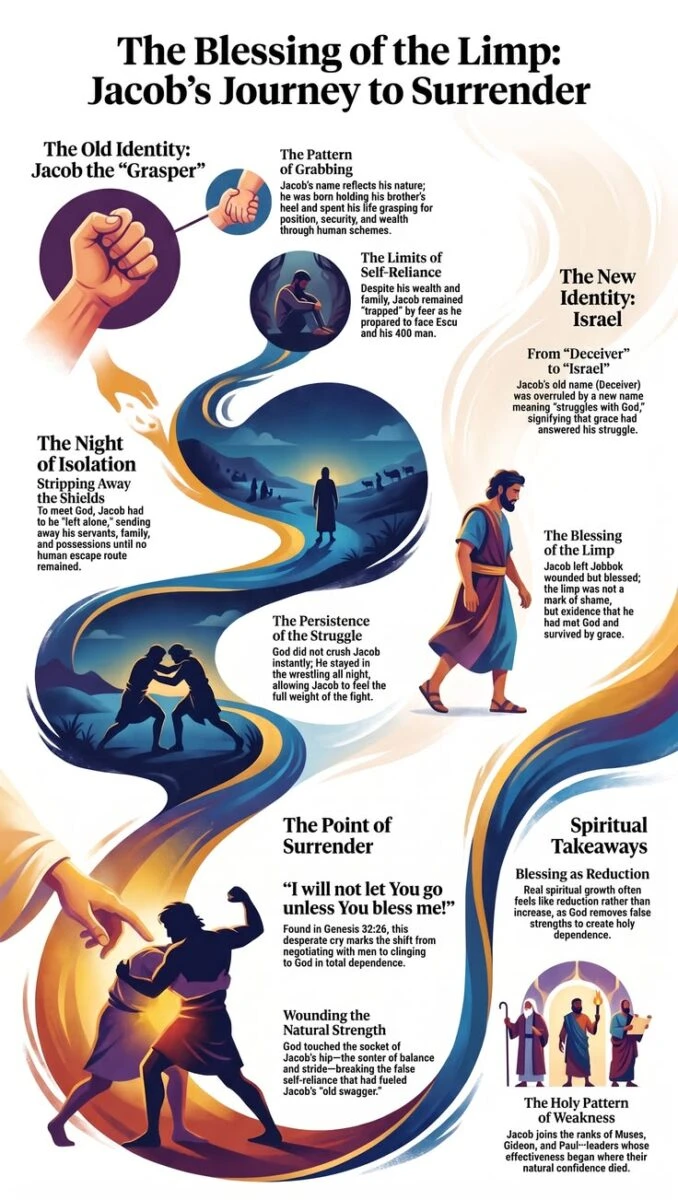
Jacob had spent much of his life running, bargaining, planning, and surviving by sharp instinct. He had taken the birthright, received the blessing, fled from Esau, worked under Laban, built a family, gained immense wealth, and still carried fear like a hidden sickness. Now, Esau was marching toward him with four hundred men, a number that did not sound like forgiveness.
Look closer at the narrative details:
- Jacob sent lavish gifts ahead to pacify his brother.
- He divided his family into separate groups to minimize loss.
- He desperately tried to control every moving part of the outcome.
His mind was moving like a trapped animal. Then night fell, and God intentionally removed the crowd.
Then Jacob was left alone; and a Man wrestled with him until the breaking of day. — Genesis 32:24, NKJV
That sentence feels quiet, but it is violent with meaning. Jacob was left alone. No servants, no wives, no clever speech, and no escape route dressed as wisdom.
This is where it gets deeply personal. You can win debates, hide your pain behind hard work, and still meet a dark night where your old tricks completely collapse. Jacob wrestled with God after every human shield had been sent across the stream. You may know that place well. It is the place where prayer no longer sounds polished. It groans. It holds on with torn hands. It refuses to let go because life without God has become unbearable.
The mysterious Man did not crush Jacob at once. That truth should disturb and comfort you. The Lord had the sovereign power to end the struggle in a single breath, yet He stayed in the wrestling. God allowed Jacob to feel the full weight of the fight because the struggle was mercy. God did not meet Jacob to destroy him; He met him to break the false self that had carried him this far.
What Is the Spiritual Meaning of Wrestling with God at Night?
Direct Answer: The spiritual meaning of wrestling with God at night represents the intense, internal struggle of surrendering our human control, pride, and false identities to the Lord. It signifies a pivotal season where our old manipulation tactics collapse, leaving us to desperately cling to God through honest, unpolished prayer until we receive His transformation.
Jacob’s entire life had been marked by grabbing. Even his name carried that dark shadow. He came from the womb holding Esau’s heel, and the pattern kept repeating. He constantly grasped for position, security, advantage, and protection.
We often fall into the exact same traps:
- Grabbing for Control: Trying to micromanage every outcome in our families, careers, and ministries.
- Rehearsing Our Fears: Lingering on worst-case scenarios instead of resting in God’s sovereignty.
- Masking Our Pride: Labeling our hyper-independence as simple “responsibility.”
Then, God steps in and touches the exact place where your pride stands upright.
And He said, “Let Me go, for the day breaks.” But he said, “I will not let You go unless You bless me!” — Genesis 32:26, NKJV
That cry does not sound polite; it sounds utterly desperate. Jacob was no longer negotiating with a brother or an employer. He was clinging to the Creator of the universe with nothing left to sell.
The truth is simple: real surrender is not passive. It is the fierce, intentional act of holding God while completely releasing your old identity. Jacob wrestled with God, and the grip that once took from others finally became a grip of pure faith.
Why Did God Touch Jacob’s Hip Socket and Leave Him with a Limp?
Direct Answer: God touched Jacob’s hip socket and left him with a limp to dismantle his natural, self-sufficient strength and serve as a lifelong reminder of holy dependence. This physical wound symbolized that true spiritual blessing requires humility, proving that divine power is made perfect when our human pride is completely broken.
A person’s hip carries their balance, movement, force, and stride. By touching the socket of Jacob’s hip, one single touch ended what an entire night of physical wrestling could not. God targeted the absolute center of Jacob’s natural strength. The man who could always flee, scheme, push, and outrun his consequences now had to walk differently.
The blessing came with a permanent limp. Jacob did not leave the Jabbok River with a crown, a trumpet fanfare, or an adoring crowd. He left marked in his body. Yet, the limp was not a mark of shame—it was historical evidence. Every single step preached that Jacob had met God and survived strictly by grace.
Many people want transformation without a wound to their pride. They want a new name without losing their old swagger. They want Israel without going through Jabbok. Scripture gives no such comfort. The Bible consistently treats weakness not as a failure, but as a canvas for divine presence:
- Moses stuttered before the face of Pharaoh but led an exodus.
- Gideon trembled in a winepress before shattering Midian.
- David wept in dark caves long before wearing the royal crown.
- Paul pleaded over his thorn, only to learn that grace stands tallest where human strength collapses.
- Peter broke completely under his own denial, only to be restored through love rather than performance.
Jacob belongs in this holy pattern. His brokenness did not cancel his blessing; it became the doorway. Jacob wrestled with God and discovered that divine favor can arrive dressed like a sudden defeat.
Modern life praises the unbroken, highly edited image. People edit the pain right out of their faces, families, and prayers. God does a much deeper work. The mind naturally protects familiar patterns, and a person can cling to painful habits simply because they feel safe. Jacob’s old identity had protected him, but it had also imprisoned him. God named the prison before He opened the door.
How Does God Transform Your Identity and Give You a New Name?
Direct Answer: God transforms your identity by confronting your past failures, removing your false coping mechanisms, and overriding your old labels with His eternal grace. Rather than ignoring your history, He redeems your struggles, replaces fear with purposeful spiritual maturity, and calls you into an authentic lifestyle of surrendered holy dependence.
When God changes your name, He completely rewrites your trajectory. He does not erase your past by pretending it never happened; He overrules it with a far greater heavenly reality.
And He said, “Your name shall no longer be called Jacob, but Israel; for you have struggled with God and with men, and have prevailed.” — Genesis 32:28, NKJV
A new name meant a brand-new story. Jacob was no longer defined by deceit, grasping, or fear. Israel meant struggle, but it also meant that grace had answered the struggle. The wound and the name belonged together.
This truth completely breaks the lie that blessing always looks like an immediate material increase. Sometimes, blessing feels exactly like a reduction. God systematically removes the false strength that keeps you from holy dependence. Your limp may be the exact part of your story you keep trying to hide from the world:
- The business failure.
- The deep grief.
- The painful betrayal.
- The persistent weakness you pray away because you fear people will misunderstand it.
But here is the shocking reality: God wants to use that exact limp as proof that you finally stopped running. Jacob wrestled with God until sunrise, and heaven answered him with a wound that became a powerful witness. He wrestled because grace had cornered him, and because divine love refused his disguise.
Walking Forward From Your Spiritual Jabbok
You cannot return from Jabbok unchanged. Jacob crossed that place with his fear behind him and Esau directly ahead of him. The family conflict remained entirely real, and the physical danger had not suddenly vanished. Yet, something deep inside Jacob’s soul had shifted. He had faced God before facing his brother.
That specific order matters immensely. You will never face the people or problems in your life rightly while your soul is still actively hiding from the Lord. To move forward into your true calling, apply these vital shifts to your spiritual walk:
- Bring Raw Honesty to Prayer: Bring your fear into prayer without cleaning it up first. Name the things you are desperately trying to control. Say it plainly: “Lord, I am afraid. Lord, I want control. Lord, I do not know how to stop running.”
- Cling to God Through the Night: Hold on to God when your feelings fluctuate, when answers delay, and when your pride screams for its old weapons.
- Embrace the Surrendered Walk: Walk forward one humble step at a time—limping, praying, obeying, forgiving, and confessing. This slow obedience may look unimpressive to the world, but heaven begins its finest work right there.
You do not need to prove you are unbroken to be blessed. You simply need to meet the God who blesses broken people without leaving them false. When Jacob called the place Peniel, he said he had seen God face to face, and his life was preserved. He did not brag about his endurance; he highlighted the mercy. That is what healed people do.
The night does not last forever. The dawn arrived for Jacob after surrender had completed its divine surgery. We may still carry physical marks, walk with heavy memories, and face people we once feared, but the Lord can make the wound speak significantly louder than the old shame.
Your old names; Deceiver, Failure, Runner, Coward, Too Damaged; may still echo in your mind. God knows those names, but He is not bound by them. He can touch what you trust most, weaken what you worship most, and beautifully bless what finally clings to Him.
Choosing to step out in this raw, faithful vulnerability is a vital cornerstone of everyday Christian living, allowing us to experience true restoration. The frightening question is not whether God can change your name; the frightening question is whether you would rather keep walking smoothly under the wrong one.
If you are ready to stop relying on your own strength and want to discover the deep power of walking under heaven’s favor, check out our complete collection on embracing divine blessings and walking in God’s favor to continue your spiritual transformation journey.