I couldn’t help but notice how many people believe they have endless time to change. I used to read The Handwriting on the Wall as a strange Bible story. Then I saw something deeper. It is a warning. It is a mirror. It reveals what happens when pride grows louder than God’s voice.
You may feel strong today. Your plans may look secure. Your future may seem untouchable. Mark my words! One moment with God can change everything. If you want to grow in faith, explore more about God’s righteous judgment because this story exposes a truth many people ignore.
What Does the Handwriting Mean Today?
The handwriting on the wall means God’s warning arrives before His judgment. It reminds you that God sees every action, weighs every heart, and responds with perfect justice. The message still speaks today because pride, rebellion, and spiritual neglect remain common in every generation.
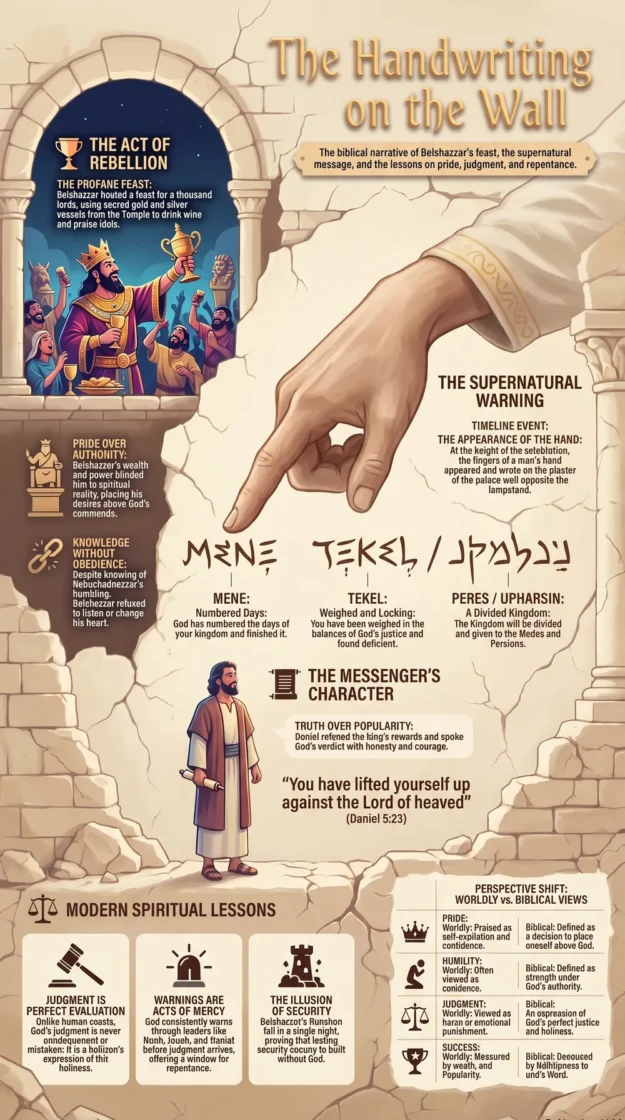
King Belshazzar celebrated while his kingdom stood on the edge of disaster. He threw a grand feast and proudly used the sacred gold and silver vessels taken from God’s temple. Those holy objects became tools for sinful worship.
Belshazzar the king made a great feast for a thousand of his lords, and drank wine in the presence of the thousand. While he tasted the wine, Belshazzar gave the command to bring the gold and silver vessels which his father Nebuchadnezzar had taken from the temple which [had been] in Jerusalem, that the king and his lords, his wives, and his concubines might drink from them.
(Daniel 5:1-2, NKJV)
That choice mattered. God does not overlook deliberate dishonor. ⚡ At the height of the celebration, a mysterious hand appeared and wrote words across the palace wall. Terror replaced confidence in seconds.
The phrase “the handwriting on the wall” has become a common saying for an obvious warning. Scripture gave it a much deeper meaning. It showed God’s final notice before judgment arrived.
Belshazzar’s Pride Before the Fall
Pride convinced Belshazzar he could ignore God’s authority without consequences. His wealth, power, and celebrations blinded him to spiritual reality. Scripture repeatedly shows that pride lifts people briefly, but it always leads toward destruction unless genuine repentance changes the heart.
Daniel’s account highlights a powerful biblical truth. Pride is far more than confidence. It is the decision to place yourself above God.
The world often praises self-exaltation. God defines humility as strength under His authority. That difference changes everything.
Humility means willingly recognizing God’s rule over your life. Its opposite is arrogance, which places human desires above God’s commands. I truly believe that every lasting spiritual transformation begins when pride dies.
“Pride goes before destruction,
And a haughty spirit before a fall.”
(Proverbs 16:18, NKJV)
King Nebuchadnezzar learned this lesson after God humbled him. Belshazzar knew that history. Daniel reminded him of it. Yet he refused to listen.
🛑 Knowledge alone never changes a heart. Obedience does.
Why Did God Write on the Palace Wall?
God wrote on the palace wall to deliver His final verdict before immediate judgment. The supernatural writing revealed that heaven had already examined Belshazzar’s life. God’s justice was complete, His decision was final, and no earthly authority could reverse His sentence.
In the same hour the fingers of a man’s hand appeared and wrote opposite the lampstand on the plaster of the wall of the king’s palace; and the king saw the part of the hand that wrote.
(Daniel 5:5, NKJV)
The mysterious words were:
- Mene
- Mene
- Tekel
- Upharsin
Daniel explained each one.
Mene meant God had numbered the king’s days.
Tekel meant Belshazzar had been weighed and found lacking.
Peres pointed to the kingdom being divided and given to the Medes and Persians.
💡 Here is something special. God never makes random judgments. Every word carried meaning. Every message reflected truth.
“And this is the inscription that was written:
MENE, MENE, TEKEL, UPHARSIN.”
(Daniel 5:25, NKJV)
Daniel’s Bold Stand Before the King
Daniel spoke God’s truth without fear because his loyalty belonged to the Lord above every earthly ruler. He refused personal rewards and delivered God’s message with honesty. Faithful believers choose truth over popularity, even when speaking truth carries serious personal risk.
Daniel had every reason to soften his words. He stood before the most powerful man in Babylon.
He refused.
I can honestly say that courage like this grows through years of faithful walking with God. Daniel had already trusted the Lord in exile, in prayer, and inside the lions’ den later in his life. His character had been shaped long before this moment arrived.
“You have lifted yourself up against the Lord of heaven.”
(Daniel 5:23, NKJV)
Daniel never attacked the king with hatred. He simply declared God’s verdict.
❖ Faithfulness means speaking truth with courage and respect.
Key Takeaway
God does not measure success by popularity. He measures faithfulness. Speaking the truth with humility honors Him, even when the message is difficult to hear.
God’s Justice Never Makes Mistakes
God’s judgment is perfectly righteous because He sees every hidden motive, every action, and every thought. Human courts make mistakes, but God’s justice never fails. His patience offers time to repent, yet His holiness guarantees that sin will never remain unanswered forever.
Many people struggle with the word judgment.
Biblically, judgment is God’s perfect evaluation of every person according to His holiness. It is never unfair. It is never emotional. It is always righteous.
The world often views judgment as harsh punishment. Scripture presents judgment as the expression of God’s perfect justice.
Jesus Himself warned people to repent before it became too late.
“Because He has appointed a day on which He will judge the world in righteousness.”
(Acts 17:31, NKJV)
Throughout history, faithful believers such as Augustine, Charles Spurgeon, Billy Graham, and John Stott consistently taught that God’s judgment is inseparable from His holiness. They also emphasized His mercy, reminding people that repentance remains open while life continues.
But wait, there’s more.
God always warns before He judges. Noah preached before the flood. Jonah warned Nineveh. Daniel warned Belshazzar.
Warnings are acts of mercy.
Lessons You Must Never Ignore
Daniel 5 reaches far beyond ancient Babylon. It speaks directly into modern life.
- You cannot build lasting security without God.
- You cannot hide pride behind success.
- You cannot delay repentance forever.
I truly believe that many people wait for a dramatic sign while quietly ignoring God’s Word every day. Scripture already contains the warnings many seek.
Remember these truths:
- God notices hidden sin.
- Pride always carries consequences.
- Repentance opens the door to mercy.
- Faithfulness matters more than earthly success.
- God’s timing is always perfect.
Important Reminder
God’s warnings are invitations to return, not reasons to despair. Every warning reveals His desire for people to turn back before judgment comes.
The Handwriting on the Wall Still Speaks
The story began with a king who believed another celebration would erase reality. It ended with a kingdom lost in a single night. That image stays with me because it reminds me how quickly life can change.
You have a choice today. You can ignore God’s voice like Belshazzar, or you can respond with humility before your own “handwriting on the wall” moment arrives. I can’t make this up. Scripture shows that repentance always begins before blessing.
Keep growing through spiritual growth and allow God’s Word to shape your heart every day. If this message challenged you, share your honest thoughts in the comments. Your story may encourage someone who needs God’s warning and His hope today.