

Your miracle may be waiting on the other side of an instruction you currently hate. That is the stinging reality inside the story of Naaman’s healing, because the command looked too small for such an important man. You want thunder, fire, and a prophet’s hand, but God may simply tell you to step into muddy water.
If you are seeking deeper insight into the restorative power of God, explore our collection of articles on healing. This journey often requires us to surrender our comfort to find true peace.
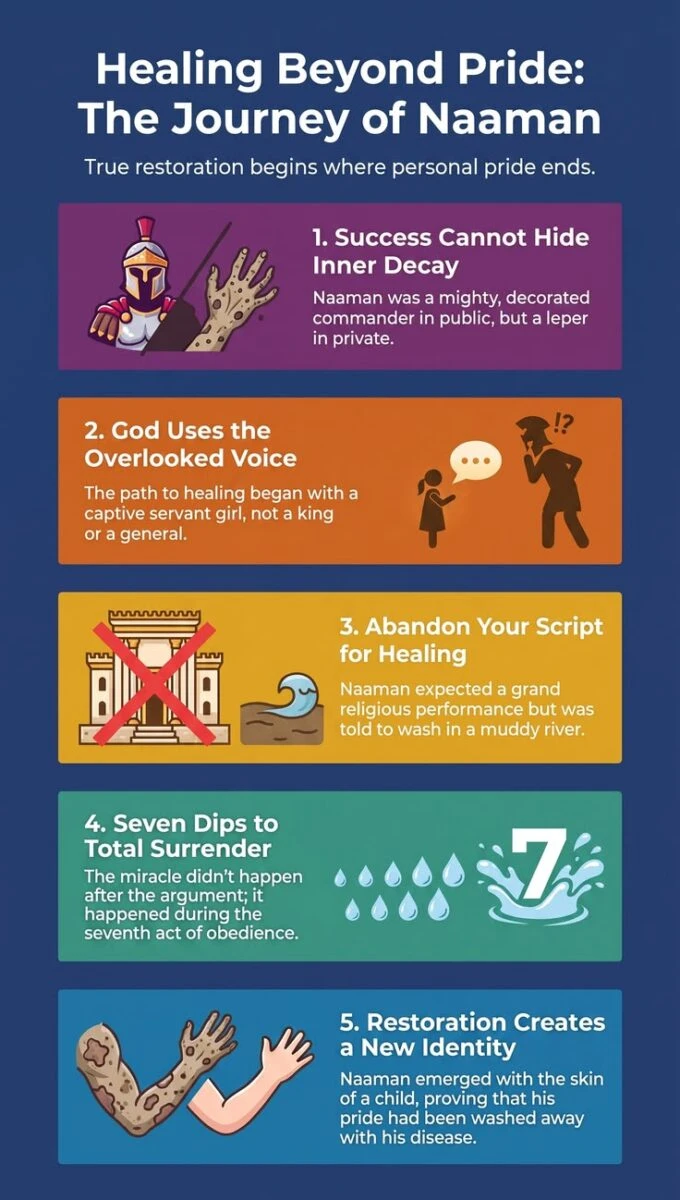
Naaman was not a weak man. Scripture identifies him as Syria’s commander, a person who was honorable and mighty. Then the narrative drops a heavy stone. He was a leper. You can win battles in the public eye while carrying hidden decay under your uniform. Naaman had medals, influence, and access to kings. Servants bowed before him. Soldiers followed his orders. Yet, no human rank could cleanse his diseased skin.
Why did God humble the commander Naaman?
God humbled Naaman to strip away his reliance on worldly power, status, and human systems of transactional exchange. The commander arrived expecting a ritual that matched his societal importance. By forcing him to submit to a simple, seemingly foolish act, God required total surrender of his ego to receive grace.
“Now Naaman, commander of the army of the king of Syria, was a great and honorable man in the eyes of his master, because by him the LORD had given victory to Syria. He was also a mighty man of valor, but a leper.” 2 Kings 5:1, NKJV
That verse refuses to offer flattery. It praises his military strength, then exposes his devastating sickness. The Bible does exactly that. It reveals the gift you possess, then points directly to the wound you keep trying to cover.
Can pride block your own divine healing?
Yes, pride acts as a spiritual barrier that prevents you from receiving God’s remedy because it makes you demand healing on your own terms. When we prioritize our dignity over divine instructions, we reject the very path toward restoration. Humility is the necessary bridge that connects human need to God’s mercy.
Naaman’s healing began through a captive girl from Israel. She lost her home, yet she carried powerful faith. She told Naaman’s wife that the prophet in Samaria could heal him. Deliverance started through a young servant girl with no social power. God did not begin with Naaman’s dignity. He began with a child he could have easily ignored. The commander needed help from someone he considered beneath him.
- You may be waiting for God to speak through someone impressive.
- A famous preacher or a polished leader might be your preference.
- The needed word may come through someone you overlooked.
Naaman went with silver, gold, and fine clothing. He carried the language of purchase. He thought healing fit the systems he understood: politics, payment, and pressure. Syria’s king wrote to Israel’s king, as if the right office could unlock the miracle. Israel’s king panicked because he could not heal leprosy. Power met disease and trembled. A throne could not do what God alone could do. That remains true in your life today.
Why did Elisha refuse to meet Naaman?
Elisha refused to meet Naaman to remove any possibility of theatrical spectacle or human worship. By sending a messenger, the prophet ensured the focus remained on God’s command rather than on the prophet himself. This forced the general to deal with his own heart rather than expecting a grand display.
“Then Elisha sent a messenger to him, saying, ‘Go and wash in the Jordan seven times, and your flesh shall be restored to you, and you shall be clean.’” 2 Kings 5:10, NKJV
Naaman expected drama. He expected the prophet to stand, call on the Lord, wave his hand over the place, and recover the leprosy. That expectation sounds spiritual, but it was pride wearing religious clothes. He had already written the script for his own recovery. You do that too. You tell God the method you prefer and the timeline you approve. Then God sends a simple instruction, and you call it disappointing.
Naaman became furious. He named better rivers, Abanah and Pharpar of Damascus. He compared those rivers with the Jordan mud. He resisted because the process offended him. The Jordan was not magic. The water held no secret power. God attached healing to obedience, then made the act low enough to expose Naaman’s heart.
Many people lose restoration here. They want God to heal them without humbling them. They want clean skin with an untouched ego. They want freedom from pain, not from the rot of pride. Naaman’s healing teaches a hard mercy.
God is kind enough to answer your cry. He is holy enough to offend your false self. If Elisha had performed a ritual, Naaman might have returned home praising the prophet. Since the answer came through obedience, only God received glory.
Naaman’s servants saved him. They spoke with wisdom and gentleness. They asked why he would refuse simplicity if he would have done greatness. Their question cut through the smoke of his anger.
“And his servants came near and spoke to him, and said, ‘My father, if the prophet had told you to do something great, would you not have done it? How much more then, when he says to you, “Wash, and be clean”?’” 2 Kings 5:13, NKJV
But do not miss this critical truth. Naaman had to listen again to servants. The pattern held steady. God kept lowering the source of instruction until the commander had no safe place left for his pride. A captive girl pointed him toward hope. A messenger gave the command. His own servants corrected his rage. That is uncomfortable grace. God may place your rescue in voices you did not plan to respect. Your spouse may see what you deny. Your child may speak truth without knowing its weight. A friend may ask one plain question that breaks years of self-protection.
Naaman went down and dipped seven times. The text hides how the first dip felt. Maybe he felt embarrassed. Maybe he remained silent. Maybe he was still angry. Obedience does not always begin with warm feelings.
“So he went down and dipped seven times in the Jordan, according to the saying of the man of God; and his flesh was restored like the flesh of a little child, and he was clean.” 2 Kings 5:14, NKJV
A warrior came out like a child. That is the beauty of Naaman’s healing. God did not return him to his old image. God gave him childlike skin, proof that pride had broken and mercy had touched him. The miracle did not happen near the river. It happened in the river. It did not happen after he argued. It happened when he obeyed. Delayed obedience often exposes hidden resistance. You may call it caution or discernment. Sometimes it is rebellion with a better name.
The gospel presses deeper than Jordan water. Jesus cleanses what Naaman’s river could only picture. He touched lepers. He restored outcasts. He carried shame outside the gate. You do not cleanse yourself before coming to God. You come because you cannot self-cleanse. Faith does not bargain with Christ while clutching pride like a trophy.
We need the river. We need the place where God’s word confronts pride and says to stop explaining. Every believer meets that place eventually. You can act today. Name the instruction you keep resisting. Write it down without excuses. Pray over it. Tell God the truth about your anger. Then take the first obedient step. For more spiritual growth, continue your journey by exploring our hope & healing hub to find strength in Christ.